
 English
 Français
 Español
 Deutsch
How to Choose the Best Cosmetic Filling Machine in 2026?
Choosing the right cosmetic filling machine in 2026 requires more than comparing speed, price, and stainless-steel finishes. Product texture matters. A thin facial serum behaves differently from a thick cream or sunscreen. A 30 ml bottle may also require tighter accuracy than a large shampoo container. Small errors become expensive across thousands of units.
Recent industry research supports a careful approach. Grand View Research estimates that the global cosmetics packaging market reached approximately USD 32.7 billion in 2022 and will continue growing through 2030. Its findings highlight demand for convenient, sustainable, and visually consistent packaging. PMMI’s 2024 packaging machinery research also identifies automation, labor shortages, flexible production, and digital monitoring as major investment drivers. These trends make a modern cosmetic filling machine valuable, but only when its features match the factory’s real process.
Jorge Izquierdo, PMMI’s Vice President of Market Development, explains, “Automation should solve a production problem, not simply add technology.” That principle deserves attention. Servo piston systems can improve repeatability for creams, while peristaltic pumps may protect sensitive liquid formulas. Tool-free changeovers can reduce cleaning delays. Still, no brochure reveals every foaming issue, dripping nozzle, or difficult-to-clean corner. I would not pretend that the fastest machine is automatically the best choice. Buyers should test their actual formula, container, filling range, cleaning routine, and future product plans before deciding. The best cosmetic filling machine is the one that delivers reliable accuracy, practical sanitation, manageable changeovers, and measurable value on the production floor.
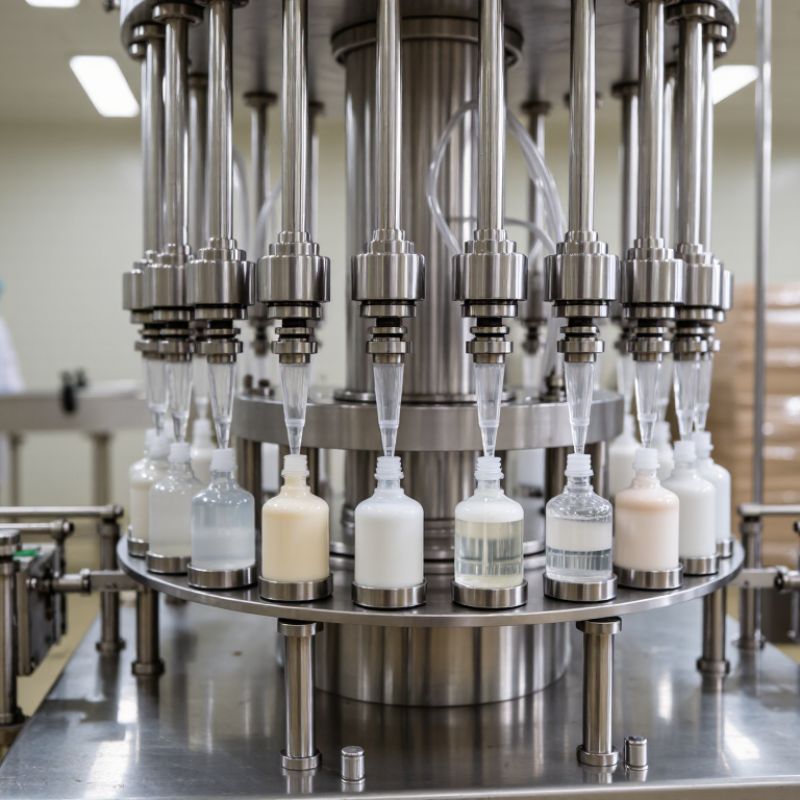
Define Product Viscosity and Dose Range Before Selecting a Filler
How to Choose the Best Cosmetic Filling Machine in 2026?
Define Product Viscosity and Dose Range Before Selecting a Filler
Viscosity and dose range should guide your machine choice, not the container’s appearance. Measure viscosity at the actual filling temperature, because creams may flow easily when warm but resist movement when cool. Record shear behavior, too. A lotion can seem stable in a beaker and behave differently inside a narrow nozzle.
Grand View Research valued the global beauty and personal care products market at approximately USD 481.6 billion in 2023. It also projects steady growth through 2030. This expansion increases pressure for repeatable dosing, lower product waste, and flexible production. For thin liquids, a time-pressure or overflow system may provide clean, fast filling. For thick creams, piston or servo-driven systems usually offer stronger control. Your target dose matters equally. A 1 ml serum requires different accuracy and tooling from a 250 ml body butter.
Tips: Create a viscosity-dose matrix before requesting quotations. Test the lowest and highest doses using real production samples. Ask for fill-weight data, not only machine speed. Check nozzle shutoff, hopper agitation, and cleaning access. These details often decide daily performance.
Do not trust a single laboratory reading. I have seen temperature drift change results more than expected. A neat spreadsheet can still mislead. Validate at startup, mid-batch, and near the hopper’s minimum level. Leave room for error; cosmetic formulas are rarely perfectly uniform. Industry reports show market growth, but factory reality is less polished.
| Product Viscosity at 20–25°C | Typical Cosmetic Products | Recommended Filling Technology | Practical Dose Range | Typical Filling Accuracy* | Important Machine Features | Recommended Product Preparation |
|---|---|---|---|---|---|---|
| 1–100 mPa·s (low viscosity) |
Micellar water, toner, facial mist, liquid serum, fragrance and thin cleansing products | Overflow filler for level-sensitive containers; piston or time-pressure filler for volumetric dosing | 5–1,000 mL | Approximately ±0.5% to ±1.0%, depending on the system and container | Anti-drip filling nozzles, liquid-level control, low-foam product path and optional diving nozzles | Minimize foaming and entrained air; use gentle transfer pumps and stable product temperature |
| 100–1,000 mPa·s (medium viscosity) |
Light lotions, emulsions, liquid foundations, shampoos, conditioners and body washes | Piston filler or servo-driven piston filler | 10–2,000 mL | Approximately ±0.5% to ±1.0% under stable operating conditions | Adjustable piston stroke, sanitary manifold, shut-off nozzles and recipe-based volume control | Maintain consistent temperature and mixing conditions; avoid excessive shear that may destabilize emulsions |
| 1,000–10,000 mPa·s (high viscosity) |
Thick creams, body butter, hair masks, sunscreens and moisturizing creams | Servo piston filler with hopper agitator or progressive-cavity pump filler | 10–3,000 mL | Approximately ±0.5% to ±1.5%, depending on temperature and product consistency | Heated hopper when required, slow-speed agitation, large-bore nozzles and positive shut-off valves | Control temperature throughout the batch; remove air before filling and prevent product settling |
| 10,000–100,000 mPa·s (very high viscosity) |
Petroleum jelly, balm, solid cream, concentrated mask and dense treatment products | Servo piston filler, progressive-cavity pump or auger-assisted filler | 5–1,000 mL | Approximately ±1.0% to ±2.0%, depending on temperature, formulation and container format | Jacketed hopper, heated product path, high-torque drive, short transfer path and customized nozzle geometry | Fill at a validated temperature; confirm that heating does not affect the formula, fragrance or active ingredients |
| Particulate or fiber-containing products | Scrubs, masks with particles, gels with beads and products containing botanical fibers | Large-port piston filler or positive-displacement pump with low-shear product handling | 20–2,000 mL | Approximately ±1.0% to ±2.0%, depending on particle size and concentration | Wide product passages, sanitary valves, low-shear pumping, anti-bridging hopper design and easy-clean components | Verify maximum particle size, prevent sedimentation and test the complete filling path with the actual formulation |
| Dose below 5 mL | Samples, eye-area treatments, concentrated serums and small-dose active formulations | Precision piston, peristaltic or time-pressure filler, selected according to viscosity and sensitivity | 0.1–5 mL | Approximately ±1.0% to ±2.0%; tighter results require validated tooling and process control | Fine-volume adjustment, low dead volume, small-bore nozzles, controlled dispensing speed and vision inspection | Use calibrated test equipment and evaluate drip, stringing, evaporation and foaming at the target dose |
| 5–100 mL | Serums, creams, liquid foundation, eye products and travel-size cosmetic products | Servo piston filler or peristaltic filler for products requiring low product contact | 5–100 mL | Approximately ±0.5% to ±1.0% with stable product conditions | Quick-change filling heads, recipe storage, diving nozzles and container-specific change parts | Confirm the actual dose by weight and volume; validate filling speed, nozzle height and container tolerance |
| 100–1,000 mL | Shampoo, conditioner, body wash, lotion and household-style personal-care products | Multi-head piston filler or flowmeter-based filler for suitable low- to medium-viscosity products | 100–1,000 mL | Approximately ±0.5% to ±1.0% | Multiple filling heads, automatic container indexing, no-bottle-no-fill logic and changeover controls | Match pump capacity and buffer-tank size to the required line speed; verify stable supply pressure |
| 1,000–5,000 mL | Professional-use shampoo, salon conditioner, bulk lotion and refill containers | Large-volume piston filler or flowmeter filler with suitable pump and nozzle size | 1,000–5,000 mL | Approximately ±0.5% to ±1.5% | Heavy-duty frame, large product manifold, container support, controlled filling speed and drip prevention | Assess container stability, handle large dose variation and allow sufficient time for product settling |
| Selection note: Viscosity values are indicative ranges measured in mPa·s (cP) at approximately 20–25°C. Cosmetic formulations can change viscosity with temperature, shear rate, aeration and storage time. Before purchasing, test the actual formula across the full dose range using the intended container, nozzle and filling speed. Accuracy figures are typical engineering targets rather than guaranteed results. | ||||||
Related Posts
-
Top 10 Cosmetic Filling Machines for Global Buyers
-
Discover Superior Quality of Best Cosmetic Filling Machines from Leading Chinese Manufacturers
-
Mastering the Selection Process for the Best Cosmetic Filling Machine in Global Markets
-

2025 How to Choose the Best Stick Pack Filling Machine for Your Business
-

Why Every Manufacturer Should Consider Investing in a Stick Pack Machine?
-
Exploring Innovative Alternatives to the Best Automatic Filling Machine