China Top 10 Paper Salad Bowl Manufacturers for Buyers?
A Paper Salad bowl may look simple, but buyers need to assess more than its shape. The right choice depends on food-contact suitability, leak resistance, lid fit, print quality, and dependable supply. Small details matter. A lid that shifts during delivery can undermine an otherwise well-made container.
The scale of the materials sector provides useful context. The FAO’s Global Forest Products Facts and Figures 2022 reports approximately 401 million tonnes of global paper and paperboard production that year. This figure covers many product categories; it does not measure salad bowls specifically. Still, it shows why buyers should ask clear questions about material specifications and sourcing rather than rely on broad sustainability claims.
This guide introduces ten China-based manufacturers for buyers comparing product ranges, customization, production capabilities, and quality documentation. It is not a universal ranking: the best supplier depends on order volume, target market, and required bowl performance. Ask for current food-contact documents, sample units, coating details, and written tolerances. Check the bowl with the actual salad, dressing, and delivery time you expect. A sample can reveal problems. It cannot guarantee every production run. Buyers should also confirm lead times, packaging, and the supplier’s process for handling defects before placing a large order.
Understanding Paper Salad Bowls and China’s Manufacturing Industry
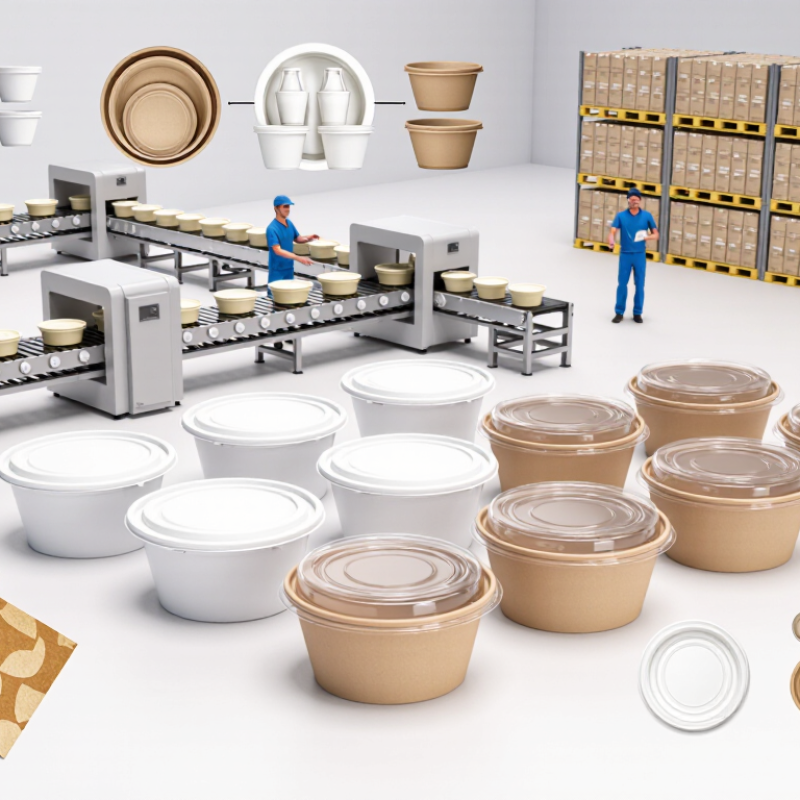
Paper salad bowls are molded or folded fiber containers designed for greens, grains, and dressings. Their usefulness depends on rim stiffness, leak resistance, and a barrier suited to oily or acidic foods. A bowl can look sturdy yet soften at the seam. That matters. Fiber choice, forming pressure, and coating weight affect stacking, transport, and the eating experience. So does testing.
China’s manufacturing base sits within a large paper-converting industry. The China Paper Association’s 2023 annual industry report records 129.65 million tonnes of paper and paperboard production, and 131.65 million tonnes of consumption. These figures cover the whole sector, not salad bowls. They show material scale, not product quality. Buyers can compare bowl capacity, rim diameter, wall thickness, and leakage performance over realistic holding times. Ask for food-contact test documents, coating specifications, and batch inspection records. A bowl filled with dressing for 30 minutes can reveal more than a glossy catalog image. Supply chains are not flawless; paper moisture and forming adjustments may cause variation. That deserves honest checking.
How to Evaluate Chinese Paper Salad Bowl Manufacturers
Choosing a Chinese paper salad bowl manufacturer takes more than comparing unit prices. Ask for bowl specifications, paperboard weight, coating details, and samples made on the same production line as your order. FAO’s Global Forest Products Facts and Figures 2023 reports that global paper and paperboard production reached about 401 million tonnes in 2022. This industry scale gives buyers many options, but it does not prove that a particular bowl is safe, leak-resistant, or consistent. Details matter.
Request current food-contact test reports and check that they cover the bowl’s actual materials and intended use. Test samples with oily dressing, chilled ingredients, and the expected serving time. Look for seepage around the base and softening along the rim. Ask how the factory controls board weight, dimensions, sealing, and batch traceability. A supplier’s certificate alone is not enough; verify its scope and issuing body. Ask for production records and agree on inspection criteria before placing a large order. Small checks help.
Compare quoted prices only after confirming bowl capacity, packaging, order quantity, and delivery terms. A cheaper quote may exclude tests or use a thinner board. I would still request a fresh sample before approving repeat orders, even when earlier batches performed well. Minor changes can be easy to miss.
How to Evaluate Chinese Paper Salad Bowl Manufacturers
Suggested buyer evaluation weights (%) for comparing suppliers. These are a practical assessment framework, not survey results or ratings of specific manufacturers.
How to use it: Request supporting documents and samples for each category, score every supplier against the same checklist, and adjust the weights to match your market, regulations, and order requirements.
China’s Top 10 Paper Salad Bowl Manufacturers for Buyers
When buyers compare China’s top 10 paper salad bowl manufacturers, the ranking matters less than how well each supplier matches the intended use. A bowl for leafy greens may need different stiffness and coating from one holding dressing or warm grains. Ask for capacity, rim diameter, paper weight, and food-contact documentation in writing. Details matter.
Request samples before discussing large orders. Fill one with salad, add dressing, and leave it for the expected serving time. Check whether the base softens, the rim bends, or the bowl leaks. Also test how lids fit during transport. A neat catalog photo cannot show these problems. It’s a small but useful reality check.
Compare factories on more than unit price. Review minimum order quantities, lead times, print options, packing methods, and their process for handling defects. Ask whether specifications stay consistent between sample and production batches. If answers are vague, pause and clarify; that is not always a deal-breaker, but it deserves attention. Buyers should also confirm whether the supplier can provide current test records for the exact bowl material and coating. Keep the agreed specifications and sample reference together, since small changes can be easy to miss.
Comparing Product Quality, Customization, and Certifications
Comparing paper salad bowl manufacturers starts with the bowl, not a glossy catalog. Ask for samples in the size and coating you plan to buy. Check whether rims stay firm, seams resist dressing, and bowls stack without sticking. A cold salad and a warm, oily topping can expose different weaknesses. Small details matter. Samples tell you more. A fair comparison is rarely neat: stronger grease resistance may affect cost or complicate recyclability claims, so ask what the coating contains and how the supplier describes disposal.
Customization should cover capacity, lid fit, bowl shape, print area, and color consistency. Confirm minimum order quantities, sample charges, and production timelines in writing. Request a printed proof before approving large runs; small text can blur on curved surfaces. Certifications need careful checking. Ask for current documents, their scope, and the exact product or facility they cover. Requirements vary by destination and intended use, so verify documents with the relevant buyer or local authority. A certificate alone does not prove every batch performs well. Compare test results, traceability details, and how the manufacturer handles defects.
 English
 Français
 Español
 Deutsch