
2026 Best Printed Aluminium Foil Suppliers for Global Buyers
Global buyers need more than a polished catalogue when choosing a printed aluminium foil supplier. They need material that performs consistently on real packaging lines, with clear specifications and dependable delivery. Printed Aluminium Foil can support product identification and shelf appeal, but print quality is only part of the decision.
Look closely at foil thickness, alloy options, coating compatibility, print registration, and ink adhesion. Ask how the supplier handles artwork approval, production tolerances, sampling, and quality checks. A small mismatch between a sample and a production roll can cause delays. Small defects matter. Request current technical data and relevant certifications, then confirm that each document applies to the product and facility being considered.
Commercial details deserve equal attention. Compare minimum order quantities, lead times, export packing, payment terms, and the supplier’s response when specifications change. Ask for a sample roll or printed proof before committing to a large order. Check how rolls are protected against moisture, edge damage, and handling during transit. These details may sound ordinary. They often shape the buying experience.
This guide introduces suppliers serving international customers and outlines practical points for comparing them. It does not treat a name on a shortlist as a guarantee of fit. Capabilities, certifications, and delivery performance can vary by product and order, so verify them directly. Even careful checks cannot remove every uncertainty. They can, however, help buyers ask better questions and make a more informed choice.
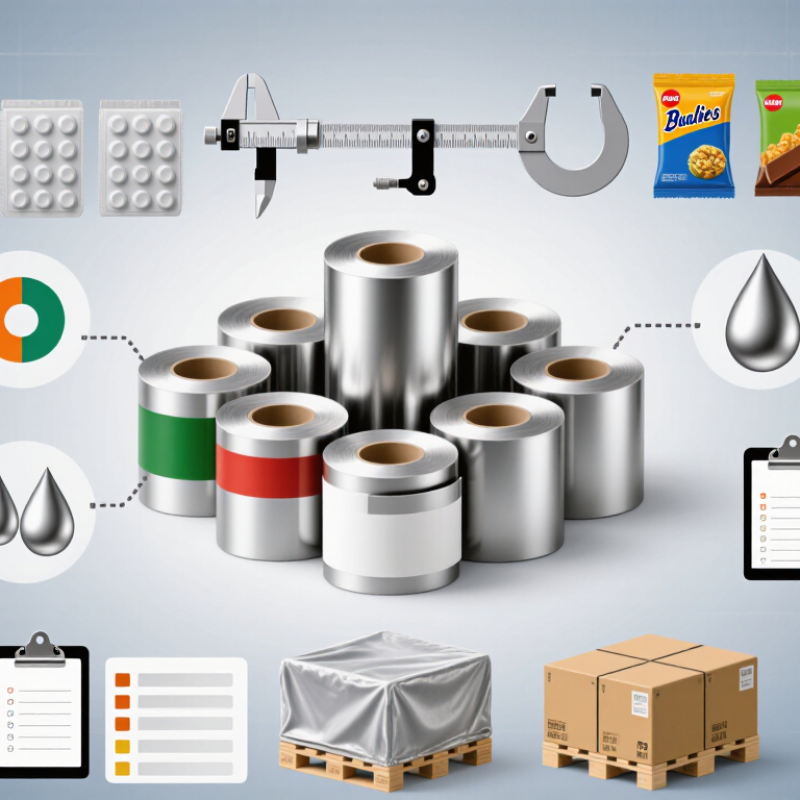
Understanding Printed Aluminium Foil and Its Global Applications
Printed aluminium foil combines a light barrier layer with graphics that help products stand out. It appears in snack wrappers, coffee sachets, dairy lids, cosmetic packs, and pharmaceutical blisters. Foil blocks light and slows moisture and oxygen transfer, but performance depends on thickness, coatings, seals, and the other laminate layers. Printing adds another variable: ink adhesion and colour consistency must hold through converting, filling, and transport.
Smithers’ 2023 report, The Future of Global Flexible Packaging to 2028, projected the flexible packaging market would approach US$300 billion by 2028. That wider market context helps explain demand for adaptable printed laminates, though it is not a forecast for foil alone. Buyers should request samples and check rub resistance, seal strength, and print registration under realistic production conditions. A glossy sample can still disappoint on a fast filling line. Small differences matter.
Tips: Match the foil structure to the product’s barrier needs, then confirm food-contact suitability and recycling options for the destination market. Ask suppliers for test data, not just a colour proof. Even so, a test pack may not reveal every issue seen during long-distance shipping.
Types of Printed Foil Suppliers and Their Manufacturing Capabilities
Printed aluminium foil suppliers generally fall into three groups: specialist printers, packaging converters, and vertically integrated manufacturers. Specialist printers focus on artwork reproduction and may offer flexographic, gravure, or digital printing. Converters often add lamination, coating, embossing, and precise slitting. Integrated manufacturers can manage more steps in-house, which may simplify production planning for large orders. Capabilities vary.
For a real comparison, ask what foil gauges, roll widths, and print processes each supplier handles routinely. Request samples with fine text, solid color areas, and metallic details. Check registration, color consistency, surface finish, and whether the foil performs well on your filling or wrapping equipment. A glossy sample can hide weak adhesion or poor handling. That matters.
Good suppliers should explain production tolerances, lead times, inspection methods, and available technical documentation. For packaging applications, confirm that the proposed materials and inks suit the intended product and use conditions; do not rely on a generic assurance. Ask whether pilot runs and retained samples are available. I would not assume the largest factory is always the safest choice. A smaller converter may offer closer process control, while its backup capacity could be limited. Compare evidence, not just promises.
2026 Best Printed Aluminium Foil Suppliers for Global Buyers – Types of Printed Foil Suppliers and Their Manufacturing Capabilities
| Supplier type | Typical products | Printing capabilities | Manufacturing capabilities | Common applications | What global buyers should verify |
|---|---|---|---|---|---|
| Integrated foil producers and converters | Printed foil rolls and converted packaging materials | May offer flexographic or gravure printing, depending on equipment and product requirements | Can combine foil sourcing or rolling with printing, slitting, and finishing; available processes vary by facility | Flexible packaging, household products, and selected industrial uses | Confirm which operations are performed in-house, foil specifications, print tolerances, and minimum order quantities |
| Specialist foil printers and converters | Printed aluminium foil reels, sheets, and cut-to-size formats | Often use flexographic or gravure processes; achievable colors and detail depend on the press, artwork, and substrate | Printing, coating or lacquering where specified, slitting, rewinding, and sheet cutting may be available | Confectionery wraps, promotional packaging, and decorative applications | Request print samples, color-control procedures, artwork requirements, and confirmation of ink suitability for the intended use |
| Flexible packaging laminators | Printed foil-containing laminates and packaging webs | Printing may be applied to foil or to another layer in a laminate, according to the construction and process | May combine printing, adhesive lamination, curing, slitting, and roll finishing | Pouches, sachets, and other flexible packs requiring a designed multi-layer structure | Check the layer structure, barrier requirements, sealability, end-use suitability, and whether the foil is directly printed or laminated |
| Pharmaceutical lidding foil converters | Printed lidding foil and specified foil-based blister packaging materials | Printing and coating are selected to suit the lidding construction and customer specification | May provide coating, printing, slitting, and controlled roll handling for lidding applications | Blister-pack lidding and other pharmaceutical packaging applications | Verify compatibility with the intended forming material and sealing process, traceability, quality documentation, and applicable regulatory requirements |
| Embossing and decorative foil converters | Embossed, patterned, or printed foil in rolls or sheets | Printing may be combined with embossing or other surface-finishing operations where equipment permits | Pattern embossing, finishing, cutting, and converting capabilities vary by supplier | Decorative wraps, presentation packaging, and selected craft or specialty products | Review texture samples, pattern repeat, surface durability, and compatibility with any downstream converting process |
Capabilities differ by supplier, production site, foil grade, and order specification. Confirm technical details and end-use compliance directly with the supplier before purchase.
How to Evaluate Supplier Quality, Compliance, and Sustainability
For global buyers, printed aluminium foil should be assessed as a production material, not just a sample. Ask suppliers for alloy and temper specifications, thickness tolerances, batch certificates, and print-performance results. Check the roll. A vivid sample may still hide weak ink adhesion or uneven coating. Request rub and bond tests, plus traceability records linking each batch to its production data.
Compliance needs evidence that matches the intended use and destination market. Request current declarations, test reports, and details of inks, coatings, and adhesives. Verify that documents cover the exact foil construction, not a similar product. Paperwork matters. It can still be incomplete, so confirm report scope, dates, and testing methods. A supplier’s quality system is useful, but it does not replace product-specific checks.
Sustainability claims also need boundaries. The International Aluminium Institute estimates that about 75% of all aluminium ever produced remains in use; this broad figure does not prove that a particular foil is recycled. European Aluminium reported a 76% recycling rate for aluminium packaging in Europe in 2022, a regional result rather than a global guarantee. Ask for product-level data, such as recycled-content evidence, energy use, and an independently reviewed environmental product declaration. Compare like with like. Even careful supplier questionnaires can miss impacts from printing, transport, or converting, so those gaps deserve a second look.
Comparing Global Suppliers by Product Range and Service
Global buyers comparing printed aluminium foil suppliers should assess both product range and service. Check available foil thicknesses, roll widths, temper options, and print capabilities. A supplier may offer vivid colors on a sample but limited repeatability across larger runs. Ask for production samples and clear specifications before comparing quotes.
Service can shape the real cost of a purchase. Review proofing steps, response times, minimum order quantities, lead-time estimates, packing methods, and export documentation. Ask how the supplier handles artwork changes or delays. Request relevant quality and material documents for your intended application and destination market. A low price is less useful if communication is slow or delivery plans keep shifting. No comparison is perfectly clean; buyers may weigh reliability differently from price.
Tips: Send every supplier the same artwork, dimensions, and target order volume. Compare written quotes line by line. Keep one sample beside the production specification during review. Also note what remains unclear. That gap matters.
Planning Costs, Logistics, and Supplier Selection for 2026
For printed aluminium foil in 2026, start with the packaging requirements, not the lowest quote. Define alloy, temper, thickness, roll width, print coverage, and sealing conditions. A small thickness change can affect stiffness, performance, and cost. Ask for a technical data sheet and samples made on the proposed production line. Samples reveal details. Check color consistency and print registration under ordinary warehouse lighting.
Compare the full landed cost, including printing plates, setup charges, minimum order quantities, production waste, freight, insurance, and import-related fees. Request quotes using the same specifications and delivery terms. Freight estimates can shift with fuel prices, seasonal capacity, and port congestion. Confirm whether the supplier quotes shipment to port or to your facility. Build in time for proof approval and transit delays. Buffers help, though they can tie up cash.
Supplier selection should include evidence of repeatable quality, not just a polished catalog. Request recent inspection records, tolerances, and a clear process for handling defects. Check production capacity against your forecast, and ask how changes to artwork or order volume affect lead time. A video call can clarify production steps, but it cannot replace independent checks where the order warrants them. Some forecasts will be wrong; review assumptions before committing to a large run.
2026 Printed Aluminium Foil Planning: Theoretical Foil Mass by Thickness
A practical reference for comparing foil specifications during supplier selection and material-cost planning. Values are calculated for plain aluminium using a density of 2.70 g/cm³; they are not supplier quotations or finished-laminate weights.
Calculation: mass per square metre (g/m²) = thickness (µm) × 2.70. Printed inks, primers, coatings, adhesives, and laminates add weight, so confirm the complete construction and tolerances with each supplier.