2026 Best Types of Barcode Security Labels for Global Buyers
Choosing the best barcode security labels in 2026 requires more than comparing adhesive strength or printing quality. Global buyers need labels that protect product identity, support traceability, and remain readable across demanding supply chains.
A pharmaceutical carton may face cold storage, condensation, and repeated handling. An electronics package may require tamper evidence and serialized tracking. Retail goods often need clean scanning through distribution centers, stores, and returns departments. These conditions make material selection essential. Polyester, destructible film, void labels, holographic foils, and chemical-resistant stocks each serve different security needs. The right choice depends on the product, environment, scan distance, and verification process.
Reliable sourcing also requires practical testing. Ask suppliers for sample rolls, adhesive data, barcode verification reports, and documented production controls. Check performance on the actual carton, bottle, or pallet surface. A label that works on coated cardboard may fail on textured plastic. Small details matter. So does supplier experience.
No label solves every risk. Even advanced barcode security labels can be weakened by poor application, unsuitable printers, or uncontrolled re-labeling procedures. Buyers should therefore evaluate the complete labeling workflow, not only the label face stock. This guide examines leading label types, security features, durability factors, and purchasing considerations for international projects. It also highlights trade-offs that product teams sometimes overlook, including cost, recyclability, scanning reliability, and regional compliance expectations. Some recommendations may need refinement after real-world trials. That is normal. Careful testing remains the most dependable path to a secure, scalable labeling program.
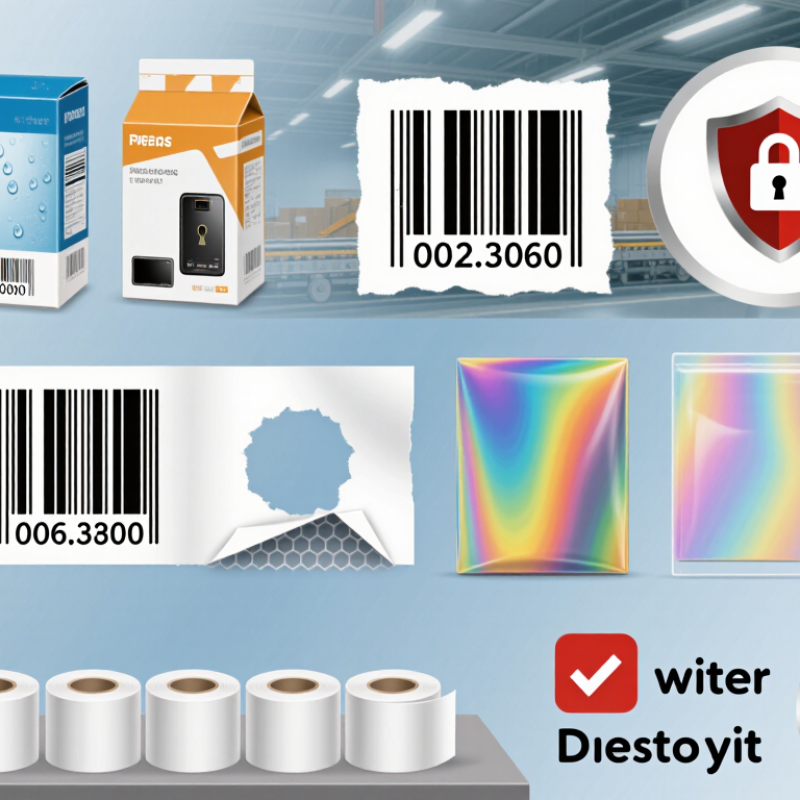
What Barcode Security Labels Are and How They Protect Products
Barcode security labels combine machine-readable data with visible or hidden tamper evidence. They identify an item and show whether packaging was opened, lifted, or replaced. A warehouse scanner reads the barcode in seconds. Meanwhile, a broken pattern can alert staff during receiving, storage, or delivery. Common formats include destructible labels, void labels, tamper-evident seals, and serialized labels. Each suits a different surface, handling condition, and verification process.
In practical warehouse checks, placement matters as much as label type. A seal crossing a carton opening creates clear evidence after removal. On curved plastic, a flexible face stock usually performs better than a rigid one. Test adhesion against dust, condensation, ink, and cold storage before purchasing at scale. A barcode that scans perfectly in a showroom may fail under shrink wrap or weak lighting. That gap is easy to underestimate.
Serialized labels can connect each package with internal records, helping teams check quantities and trace handling events. Clear numbering also reduces confusion during returns and stock transfers. The label material should match expected heat, moisture, friction, and storage time. No label stops every loss. Staff still need simple inspection steps and reliable scanning habits. In my view, buyers sometimes overvalue advanced features and under test basic adhesion. That is an expensive oversight.
2026 Best Types of Barcode Security Labels for Global Buyers
What Barcode Security Labels Are and How They Protect Products
This chart compares commonly used barcode security label constructions by their inherent protection functions. A value of 1 means the capability is typically built into that label type, while 0 means it is not inherent. Features can be combined, such as pairing a serialized 2D barcode with a tamper-evident or destructible label material.
Key Features to Compare When Selecting Security Labels
2026 Best Types of Barcode Security Labels for Global Buyers
When comparing security labels, start with barcode performance, not appearance. A label should maintain readable contrast, quiet zones, and correct symbol size. ISO/IEC 15415 supports quality grading for two-dimensional symbols, while ISO/IEC 15416 applies to linear barcodes. Ask suppliers for verification reports, not only scan demonstrations. In warehouse trials, test labels under dim lighting, curved surfaces, dust, and repeated handling. A perfect scan grade does not guarantee dependable field performance.
Tamper evidence is equally important. Destructive materials, void patterns, cut lines, and residue can reveal unauthorized opening. However, a dramatic visual effect may slow packing or confuse operators. Choose the smallest feature that clearly shows interference. The OECD and EUIPO reported that counterfeit goods represented up to 2.5% of global trade, based on 2021 customs data. That figure supports stronger traceability, but a security label cannot replace controlled inventory processes.
Compare adhesive strength, temperature range, moisture resistance, and print durability. Thermal transfer printing often suits demanding logistics, while direct thermal printing may fade under heat or sunlight. Check whether the label remains attached to cardboard, plastic, glass, or coated metal. IBM’s Cost of a Data Breach Report 2024 placed the global average breach cost at $4.88 million, showing why data protection also matters. Avoid encoding unnecessary personal information. Serialization, controlled access, and audit records are usually more useful. One weakness remains: buyers often test labels for seven days, although shipments may face months of abrasion and climate changes. Longer pilot testing is wiser.
Global Buying Standards for Barcode Security Labels in 2026
Global buyers should treat barcode security labels as traceability components, not simple stickers. GS1’s Sunrise 2027 materials call for broader use of two-dimensional barcodes at retail points of sale. This shift increases expectations for data capacity, scan reliability, and digital identification. Buy labels that support serialized product data, controlled numbering, and clear ownership of records.
Quality must be measurable. ISO/IEC 15415 evaluates two-dimensional barcode print quality on a 0–4 scale, while ISO/IEC 15416 applies to linear symbols. Ask suppliers for recent verification reports, not only sample images. Test labels on cartons, curved containers, and shrink-wrapped goods. Check performance after heat, moisture, abrasion, and cold storage. Small details matter. A glossy surface can reflect scanner light. Weak adhesive can expose a clean removal path.
Security features should match the risk. Destructible materials reveal damage during removal, while tamper-evident adhesives leave visible patterns or residue. For international shipments, buyers should confirm substrate compliance, ink durability, roll direction, core size, and language-free inspection marks. In practical audits, the label often passes the first scan but fails after handling. That weakness is easy to underestimate. It may be wiser to require pilot testing across three climates before signing a large order. Perfect specifications still need real-world evidence.
 English
 Français
 Español
 Deutsch