 English
 Français
 Español
 Deutsch
2026 Top Sandwich Cake Machine Buying Guide
Choosing a Sandwich Cake Machine in 2026 takes more than comparing prices or production speeds. The right model must handle your recipes, daily output, available floor space, and cleaning routine. A machine that performs well during a short demonstration may behave differently after hours of steady production. Details matter.
This guide uses a practical, illustrative quotation from fictional food-equipment specialist Daniel Wu: “Judge a machine by the cakes it makes consistently, not by its fastest cycle.” Treat that as a buying principle, not a sourced interview. Compare portion accuracy, layer alignment, filling control, changeover time, and access to parts. Ask suppliers for a live trial using your batter, filling, and target portion size. Watch how operators load trays, clear crumbs, and clean contact surfaces. These steps reveal problems a polished brochure may miss.
Fit matters. A compact bakery may value flexible settings and quick changeovers, while a larger plant may prioritize repeatable output and service support. Check the machine’s footprint, power requirements, guarding, and stated food-contact materials against your actual installation needs. Request written specifications and confirm what the warranty covers. Do not assume every accessory is included. This guide will help buyers ask sharper questions, compare machines on practical evidence, and recognize where estimates remain uncertain. Real production conditions can still surprise you.
What Is a Sandwich Cake Machine and How Is It Used?
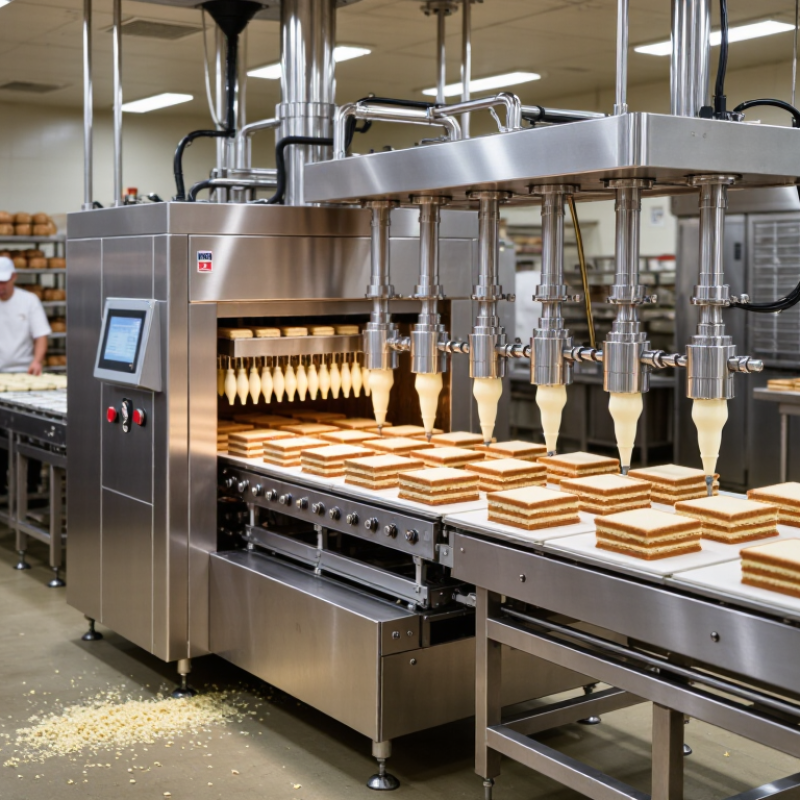
A sandwich cake machine is equipment designed to produce layered cakes with a filling between sponge sheets. Depending on its configuration, it may portion batter, bake thin layers, spread cream or jam, stack sheets, or cut finished cakes. Some machines handle only assembly, so buyers should check which stages are actually automated. The name can sound more standardized than the equipment really is.
In use, operators prepare a consistent batter and set the machine’s portion size, temperature, speed, and filling amount. The layers then move through baking or assembly stages, followed by cooling and cutting. Watch the first few cakes closely. Uneven sheets or warm filling can make layers slide, even when machine settings look correct. Small differences matter. Staff should also follow the equipment manual for cleaning food-contact parts and checking moving components. A machine can improve portion consistency and reduce repetitive work, but it cannot rescue a poorly mixed batter. That is easy to forget during a busy shift. Before choosing one, compare its capacity with your daily output and confirm that its layer thickness and filling system suit your recipes.
| Topic | What It Means | Typical Options or Process | What to Check Before Buying |
|---|---|---|---|
| Machine definition | A sandwich cake machine automates one or more steps in assembling cake layers with a filling between them. | Depending on the model, it may deposit filling, align layers, press or transfer the assembled cake, or combine several of these operations. | Confirm exactly which steps are included; the term does not describe one standard machine configuration. |
| Typical product | A layered cake made from two or more cake sheets or pieces with cream, jam, icing, or another suitable filling between layers. | Products can be round, rectangular, or formed in other shapes, depending on the feed system and tooling. | Test the machine with the actual cake dimensions, softness, surface condition, and filling recipe. |
| Basic operating sequence | The machine positions a cake layer, applies filling, and places or aligns another layer to form a sandwich. | A production line may then include cooling, cutting, decoration, or packaging equipment. | Check how the machine connects to upstream baking and downstream handling equipment. |
| Filling system | Controls how filling is delivered to the cake layer. | Possible methods include depositing through nozzles or spreading through a dispensing head; suitability depends on filling texture and temperature. | Ask about portion adjustment, nozzle or head changes, drip control, and performance with the intended filling. |
| Layer handling | Moves and aligns cake layers while limiting breakage or distortion. | Feed systems may be manual, semi-automatic, or integrated into an automated line. | Evaluate alignment accuracy, product changeover, and handling of fragile or irregular layers. |
| Capacity and speed | Output depends on the machine design, product size, filling method, operator input, and line layout. | Manufacturers may state output as cakes per minute or per hour; these figures are not directly comparable unless product and operating conditions match. | Request a production test using your product and confirm whether quoted output is sustained operating output or a maximum rate. |
| Product flexibility | Describes how readily the equipment can handle different cake sizes, shapes, layer counts, or fillings. | Flexibility may require adjustable guides, interchangeable parts, or recipe and setting changes. | Check the supported product range and the time, tools, and parts required for changeovers. |
| Controls and dosing | Controls help operators set and repeat machine functions such as conveyor movement and filling delivery. | Control complexity varies by model; some machines use basic adjustments, while others offer programmable settings. | Check setting repeatability, operator training needs, and whether filling quantity can be adjusted for each product. |
| Cleaning and hygiene | Food residue and allergens must be managed through suitable cleaning procedures and equipment design. | Removable product-contact parts and accessible surfaces can make inspection and cleaning easier. Food-contact materials should be identified by the supplier. | Ask for cleaning instructions, disassembly steps, material documentation, and compatibility with the facility’s sanitation procedures. |
| Installation requirements | The machine must fit the available production space and connect to required utilities and line equipment. | Requirements vary by model and may include electrical supply, compressed air, conveyor connections, and access for cleaning and maintenance. | Obtain the machine footprint, utility specifications, service clearances, and installation requirements before ordering. |
| Maintenance and support | Routine inspection and maintenance help keep the equipment operating consistently. | Common considerations include wear parts, lubrication requirements, spare-part availability, and access to technical support. | Request a maintenance schedule, recommended spare-parts list, warranty terms, and training details. |
| Best-fit buying approach | The right machine is the one that fits the product, production target, workforce, and plant layout. | Compare equipment using the same cake size, filling, operating hours, and cleaning expectations. | Prioritize a product trial and a written specification covering output, changeover, cleaning, utilities, and support. |