
 English
 Français
 Español
 Deutsch
2026 Top PCR Thermal Cycler Types How to Choose?
Choosing a Pcr Thermal Cycler in 2026 requires more than comparing screen size, sample capacity, or purchase price. Each platform affects amplification quality, workflow speed, maintenance effort, and long-term laboratory confidence. Conventional cyclers suit routine endpoint PCR, while gradient models help optimize uncertain primer conditions. Real-time systems support fluorescence-based quantification, but they demand stronger calibration and data interpretation skills.
Small details matter. A heated lid should maintain stable contact across every tube. Temperature uniformity should be verified, not simply accepted from a brochure. For example, a laboratory processing 96 samples may value uniformity and automation more than a compact design. A teaching laboratory may prioritize clear controls and simple programming. Published protocols, manufacturer validation data, warranty terms, and local technical support deserve careful review. Independent performance studies are useful, although they may not represent every sample type.
No instrument is perfect.
Selection should begin with the application, not the sales image. Consider reaction volume, ramp speed, block format, gradient range, software traceability, contamination control, and future assay plans. Experienced users also check service records and consumable availability before approval. A fast cycler can still disappoint when calibration is neglected or operators lack training. That assumption can fail.
This guide examines major Pcr Thermal Cycler types and explains how their practical strengths differ. It connects technical specifications with daily laboratory realities, including failed controls, uneven optimization, and limited bench space. The recommendations are evidence-informed, but they should be confirmed against validated methods and institutional requirements. A thoughtful choice may not be the most advanced one. It should be the one that produces dependable results, day after day.
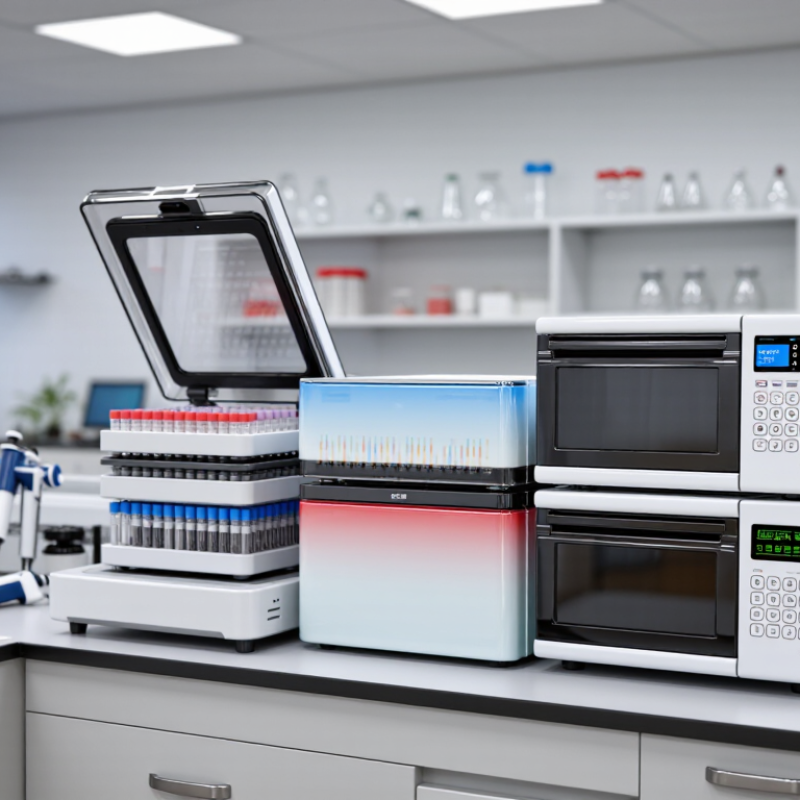
What Is a PCR Thermal Cycler and How Does It Work?
A PCR thermal cycler is a laboratory instrument that controls temperature during polymerase chain reaction testing. It repeatedly changes between programmed temperatures with precise timing. This cycling separates DNA strands, allows primers to attach, and supports new strand formation. During denaturation, heat separates double-stranded DNA. During annealing, the temperature drops so primers bind to matching sequences. During extension, a heat-stable polymerase builds new DNA strands. The machine repeats these steps many times. Small timing errors can affect amplification.
In practical laboratory work, thermal cyclers differ in purpose and control features. A conventional cycler produces amplified DNA for later analysis. A gradient model tests several annealing temperatures in one run, which helps refine an unfamiliar protocol. A real-time cycler measures fluorescence during amplification and provides quantitative results. Digital PCR systems divide samples into many reactions for highly sensitive measurement. Each type has limits. More functions do not always mean better results.
For a 2026 purchase, start with the assay’s actual needs. Confirm temperature uniformity, ramp speed, block capacity, and software traceability. Consider sample volume and the number of tubes or wells used daily. Reliable calibration matters more than attractive interface design. It is tempting to choose the fastest system. That choice may increase cost without improving your assay. A careful technician should also check maintenance access, validation records, and training requirements. Protocols change, and a rigid instrument can become inconvenient sooner than expected.
2026 Top PCR Thermal Cycler Types: How to Choose?
What Is a PCR Thermal Cycler and How Does It Work? A practical comparison of major thermal-cycling platform types and their typical use cases.
| PCR Thermal Cycler Type | How It Works | Typical Sample Format | Typical Throughput | Temperature-Control Characteristics | Detection Method | Best Applications | Main Advantages and Limitations |
|---|---|---|---|---|---|---|---|
| Conventional Block Thermal Cycler | Repeatedly changes the temperature of a reaction block through denaturation, primer annealing, and extension steps. Amplified DNA is normally analyzed after cycling. | 0.2 mL tubes, tube strips, or multiwell plates | Commonly 24, 48, 96, or 384 reaction positions, depending on the block configuration | Programmable cycling generally covers approximately 4–100°C. Temperature uniformity and ramp rate vary by instrument design. | Usually endpoint analysis by agarose gel electrophoresis, fragment analysis, or other post-PCR methods | Routine DNA amplification, cloning, genotyping, sequencing preparation, and teaching laboratories | Advantages: versatile, comparatively simple, and suitable for many assays. Limitations: does not directly measure product accumulation during amplification and usually requires post-PCR handling. |
| Gradient Thermal Cycler | Performs PCR across different annealing temperatures in separate rows or zones during the same run, helping identify a suitable primer annealing temperature. | Tubes, tube strips, or 96-well plates | Commonly 24–96 reactions per run, with the exact usable capacity determined by the block | Provides a programmed temperature gradient across part of the block, often spanning several degrees Celsius in one experiment | Usually endpoint detection using gel electrophoresis or another post-PCR method | New primer-pair optimization, assay development, multiplex PCR setup, and troubleshooting | Advantages: reduces the number of separate optimization runs. Limitations: gradient zones may have different effective temperatures, and it is not a substitute for quantitative real-time detection. |
| Fast or High-Speed Thermal Cycler | Uses rapid heating and cooling, reduced reaction volumes, and optimized protocols to shorten the total time required for thermal cycling. | Small-volume tubes, strips, plates, or specialized consumables | Often 16–96 reactions per run; capacity depends on the block and consumable format | High ramp rates can shorten runs, but the recommended protocol must account for reaction volume, ramp performance, and thermal equilibration | Primarily endpoint detection; some fast systems also support fluorescence-based real-time detection | Time-sensitive testing, high-volume routine workflows, field or near-patient laboratory workflows, and rapid research screening | Advantages: shorter run time and improved workflow efficiency. Limitations: fast cycling does not automatically improve assay sensitivity; reagent formulation and validation remain essential. |
| Real-Time Quantitative PCR (qPCR) System | Combines thermal cycling with fluorescence measurement during each cycle, allowing amplification to be monitored as it occurs and quantified through a cycle-threshold or related analysis. | Optical tubes, tube strips, or sealed optical plates | Commonly 48, 96, or 384 reactions per run | Uses programmable thermal cycling, often with melting-curve analysis for assays that require product or primer-dimer discrimination | Fluorescent DNA-binding dyes or sequence-specific fluorescent probes; available optical channels vary by system | Gene-expression analysis, pathogen detection, genotyping, copy-number studies, and quantitative nucleic-acid testing | Advantages: quantitative results, closed-tube monitoring, and reduced post-PCR contamination risk. Limitations: higher cost, optical calibration requirements, and greater dependence on assay controls and reference standards. |
| Digital PCR System | Distributes a sample into many individual reaction partitions, performs endpoint PCR, and estimates target concentration from the proportion of positive and negative partitions using Poisson statistics. | Partitioned droplets, chambers, or microwells created by a dedicated consumable | Commonly thousands to hundreds of thousands of partitions per sample, depending on the partitioning method | Uses thermal cycling similar to endpoint PCR, with instrument-specific protocols for partition integrity and endpoint fluorescence | Endpoint fluorescence, usually with target-specific probes or multiplex fluorescent assays | Rare-variant detection, low-level mutation analysis, copy-number measurement, nucleic-acid quantification, and challenging samples with inhibitors | Advantages: high sensitivity and absolute quantification without a conventional external standard curve. Limitations: higher consumable cost, more complex workflow, and lower practical throughput for some applications. |
| In-Situ or Slide-Based Thermal Cycler | Controls the temperature of reactions performed directly on microscope slides, tissue sections, or specialized imaging vessels, allowing amplification and spatial observation in the same workflow. | Slides, tissue sections, or specialized imaging chambers | Usually lower throughput than plate-based systems; capacity is defined by the slide or chamber layout | Requires precise thermal uniformity across a relatively flat reaction area and compatibility with imaging hardware | Fluorescence imaging, microscopy, or endpoint imaging; real-time capability depends on the system configuration | Spatial biology, tissue analysis, in-situ amplification, and research workflows requiring localization of nucleic-acid signals | Advantages: preserves spatial information and can combine amplification with microscopy. Limitations: specialized consumables, more demanding optimization, and limited suitability for routine high-throughput PCR. |
| Portable or Field Thermal Cycler | Performs programmable thermal cycling in a compact instrument designed for transport, decentralized testing, or operation outside a conventional laboratory. | Small tubes, cartridges, strips, or compact reaction plates | Commonly 1–32 reactions per run, although larger portable formats are also available | Typically supports standard PCR temperature steps, with power consumption, heat dissipation, and environmental conditions influencing performance | Endpoint fluorescence, lateral-flow readout, or compact real-time fluorescence, depending on the system | Field surveillance, environmental testing, teaching, mobile laboratories, and decentralized molecular testing | Advantages: compact size, portability, and reduced infrastructure requirements. Limitations: lower throughput, potentially fewer optical channels, and greater dependence on battery, ambient temperature, and workflow design. |
Selection guideline: Choose a conventional cycler for routine endpoint amplification, a gradient model for primer optimization, a fast model when turnaround time is the priority, qPCR for fluorescence-based quantification, digital PCR for highly sensitive or absolute quantification, and a portable system when testing must be performed outside a standard laboratory. Actual well capacity, ramp rate, temperature uniformity, optical channels, and run time vary by instrument configuration.